Creatine, Considered: The Most Studied Powder in the Cupboard
An unglamorous white powder with a two-century history and an unusually plain job. What creatine is, where it comes from, how a daily serving fits into an ordinary week, and why purity matters more than flavour.
Wellness has a weakness for novelty, which makes creatine an unusual survivor. It is not new, not exotic and not especially interesting to look at — a fine white powder, unflavoured, dissolved in water each morning. It has simply remained useful long enough to stop needing an introduction.
What creatine actually is
Creatine is a nitrogen-containing compound built from amino acids. The body produces some of it in the liver, kidneys and pancreas, and takes in the rest through the diet — red meat and fish being the most concentrated dietary sources. Most of it is stored in skeletal muscle.
In muscle it exists largely as creatine phosphate, part of the body's fastest energy system: the one that supplies very short, very demanding efforts — a sprint, a heavy set, a flight of stairs taken quickly. That system relies on rapidly regenerating ATP, the molecule cells use as immediate currency, and creatine phosphate is what makes that regeneration quick.
A short history
Creatine was identified in 1832 by the French chemist Michel Eugène Chevreul, who isolated it from meat extract and named it after the Greek kreas, meaning flesh. For most of the following century it belonged to laboratories rather than kitchens. Its move into everyday use came much later, once it became possible to produce a stable, pure powder at reasonable scale.
That history is part of why the ingredient is treated with such calm by people who work with it. It has been examined for a very long time, in a very ordinary way.
Why monohydrate
Creatine is sold in several chemical forms, most of which arrive with a marketing story attached. Monohydrate is the plainest of them — creatine bound to a single molecule of water — and it remains the reference form: the one that is easiest to produce consistently, easiest to verify, and the least dependent on explanation.
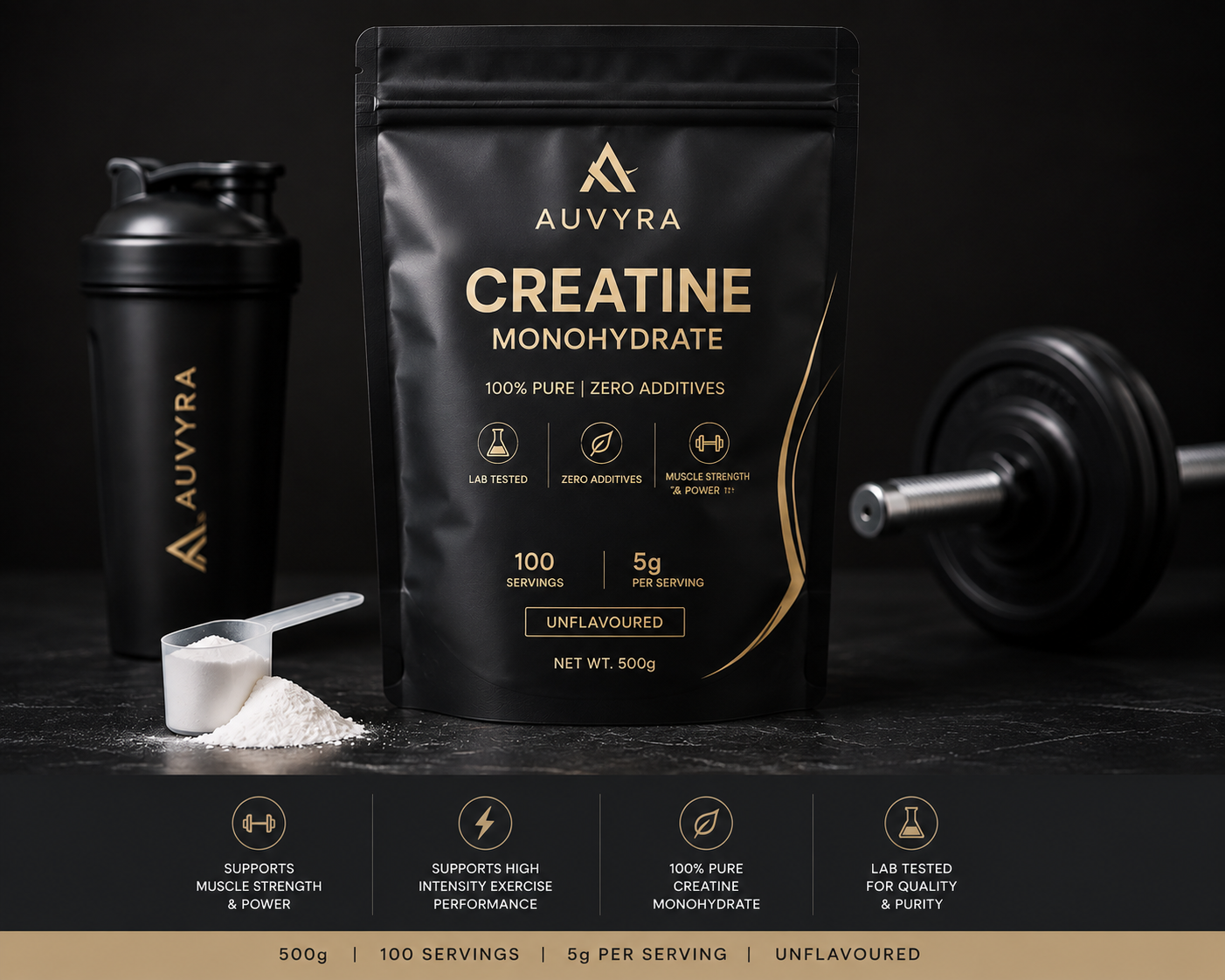
AUVYRA Creatine Monohydrate is exactly that and nothing else: 100% creatine monohydrate, unflavoured, with no additives, sweeteners, fillers or colours. It is lab tested for quality and purity and made in a GMP-certified facility. A single ingredient is an easy thing to state honestly, which is much of its appeal.
How it fits into a week
The serving is 5 g — one scoop — mixed into 200–250 ml of water or a beverage of your choosing, taken daily. There is no ceremony to it, and no ideal hour. The habit is the mechanism: creatine works on the basis of what is stored in muscle over time, which is a matter of ordinary consistency rather than timing.
- Mix into water, milk or a smoothie; unflavoured means it disappears into whatever you already drink.
- Stir well — monohydrate dissolves more readily in slightly warmer liquid, and a little sediment is normal, not a defect.
- Take it daily, including on days you do not train.
- Drink water across the day as you normally would.
Practical care
Store the pouch sealed in a cool, dry place away from direct sunlight, and keep the scoop dry — moisture is the one thing a fine powder does not forgive. Reseal properly after each serving and keep it out of reach of children.
What this means for your ritual
AUVYRA's interest in creatine is the same as its interest in a serum: a simple step, taken consistently, that asks very little of your day. It belongs beside the unremarkable habits — sleep, movement, water, a diet you actually enjoy — rather than in competition with them.
Practical takeaways
- 01Creatine occurs naturally in the body and in food; monohydrate is the plainest and most widely used supplemental form.
- 02One 5 g serving daily in 200–250 ml of liquid; consistency matters more than timing.
- 03Keep the pouch sealed and dry, and treat it as a supplement to a nutritious diet rather than a substitute.
Continue the ritual
Follow the serving directions and warnings on the pack. Formulated supplementary sports food.