Peptides, Explained Without the Noise
Short chains of amino acids with unusually long marketing careers. What peptides are, why they appear in almost everything, and why the count on the box is the least interesting number.
Peptides have reached the stage of ubiquity where the word functions as reassurance rather than information. It appears on serums, creams, eye products and mists, and it rarely comes with an explanation. So here is one.
What a peptide is
Amino acids are small molecules that the body uses as building blocks — string enough of them together in the right order and you have a protein. A peptide is a much shorter chain of those same amino acids: too short to be a protein, long enough to have a specific structure and behave in a specific way.
That is the whole concept. Everything else is a question of which peptide, at what level, in what formula.
Why they appear in skincare
Cosmetic chemists like peptides because they are stable, generally gentle and easy to formulate with. They rarely sting, they do not demand an unusual pH, and they layer well with hydrating ingredients.
Consumers seek them out for the appearance of smoother, firmer, better-conditioned skin. That is a fair expectation of a well-made peptide product, provided it is framed correctly: gradual, cumulative changes in how skin looks and feels, sustained by continued use.
Not all peptides are the same peptide
Peptides are described in families — signal peptides, carrier peptides, neuropeptides and others — and different peptides are chosen for different cosmetic functions. Two products can both be 'peptide serums' and share almost nothing in common in terms of what they were designed to do or how they feel.
Which is why the useful question is never 'does this contain peptides?' but 'what has this formula been built to do, and does that match what I want from this step?'
The myth: more peptides means a better product
It is an appealing rule because it is easy to check on a box. It is also not a useful one. A formula with a small number of well-chosen peptides at meaningful levels, supported by good hydrators and a texture you will actually enjoy using, will generally serve you better than a long list included largely so it can be printed.
The honest promise of a peptide is quiet improvement in how skin looks, sustained over months — not transformation over a weekend.
What this means for your ritual
- Consistency does the work. Use the product as directed, daily or twice daily, and judge it at four weeks rather than four days.
- Layer by texture, not by ambition — a watery peptide serum goes before a cream, not after it.
- Follow with a moisturiser if your skin needs one, and sunscreen in the morning.
- If you also use a strong exfoliating acid or retinoid, consider alternating evenings rather than stacking everything into one.
If your skin is sensitive
Patch test on a small, discreet area first, and introduce one new product at a time. If you change three things at once and your skin objects, you have learned nothing about which one was responsible.
The AUVYRA example
The PDRN Pink Peptide Serum is where peptides appear in the current range. A five-type peptide complex sits alongside PDRN (sodium DNA) at 1%, supported by humectants and skin-conditioning agents: the complex for the look of smooth, hydrated skin, the humectants so the serum spreads evenly and leaves skin comfortable rather than tight.
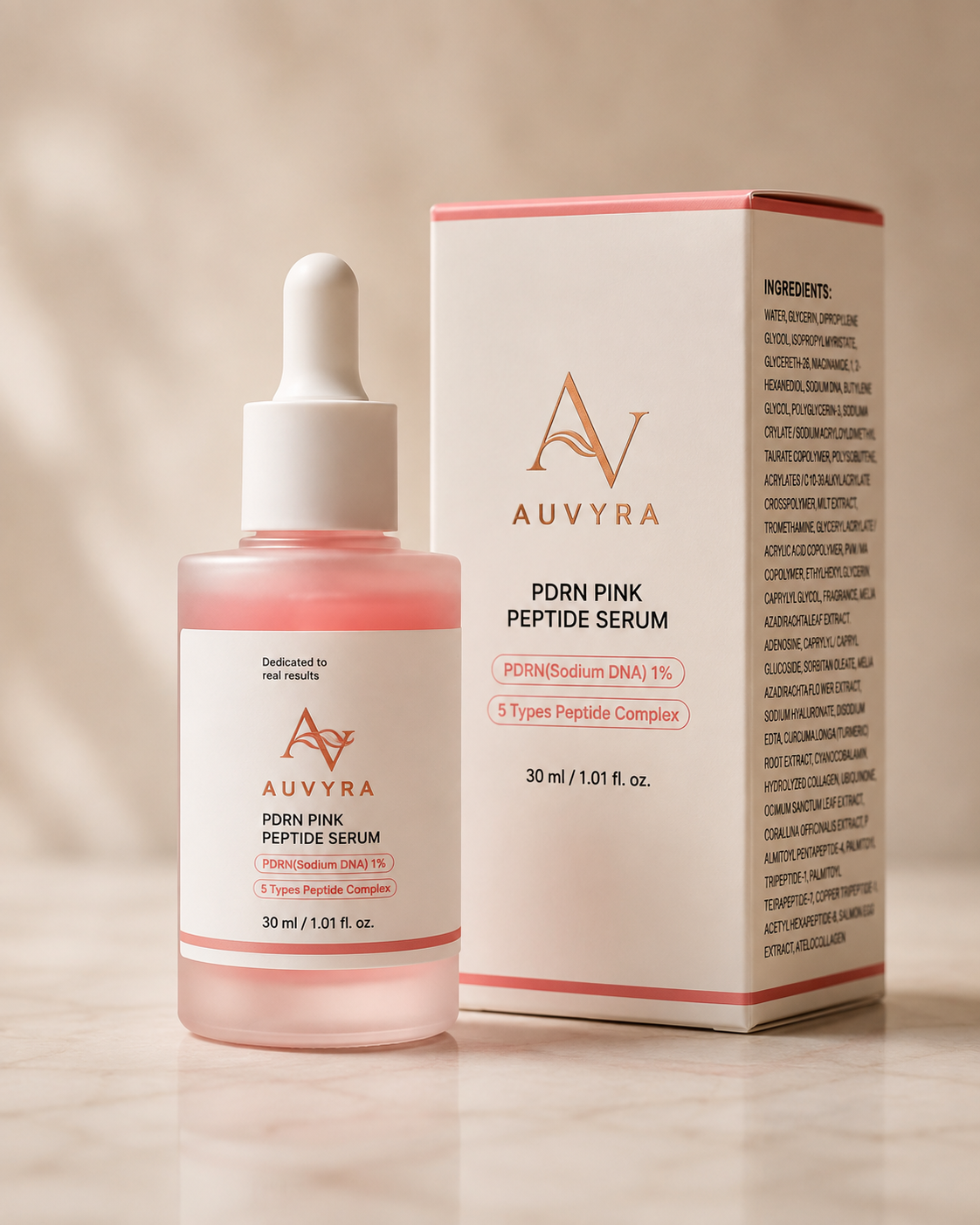
Two or three drops, patted into clean skin morning and evening, before moisturiser. A small quantity used consistently is how a peptide formula is meant to be judged — which is why we would rather talk about the habit than the ingredient list. PDRN itself is covered properly in its own guide; there is no need to repeat it here.
Practical takeaways
- 01Peptides are short amino-acid chains used for a range of cosmetic purposes — the specific formula matters more than the category.
- 02Ignore peptide count as a quality signal.
- 03Introduce one product at a time and give it a month before judging it.
Continue the ritual
Pieces from the AUVYRA range that relate to this reading. Availability shown is live.